
Running a business in 2026 means dealing with more information, faster customer expectations, tighter budgets, and constant pressure to do more with existing resources.
That is where AI tools for business can make a meaningful difference.
Modern business AI is no longer limited to chatbots or content generators. Today’s tools can help teams analyze documents, summarize meetings, automate workflows, create marketing campaigns, manage projects, answer customer questions, research markets, and turn business data into useful insights.
The important part, however, is choosing the right tools for the right workflows. A business does not become more efficient simply by subscribing to ten different AI platforms. The strongest results usually come from a focused technology stack that fits the company’s existing software, processes, budget, and security requirements.
Recent business-tool comparisons increasingly emphasize this point: the best solution depends heavily on the company’s existing ecosystem and primary use case.
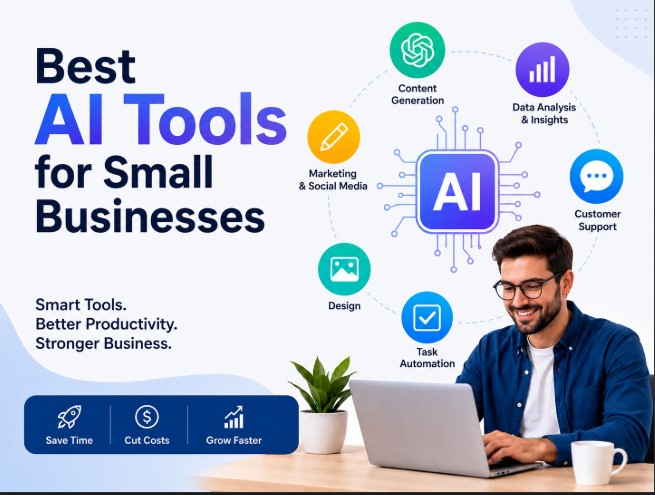
In this guide, we’ll examine 15 of the best AI tools for business in 2026, explain what each one is good at, and show how business owners, startups, marketing teams, operations teams, and larger companies can use them effectively.
What Are AI Tools for Business?
AI tools for business are software applications that use artificial intelligence to help organizations complete tasks, analyze information, automate processes, or make better decisions.
They can support almost every department, including:
- Marketing and content
- Sales and lead generation
- Customer service
- Finance and accounting
- Human resources
- Project management
- Data analysis
- Research
- Software development
- Internal communications
- Operations
For example, an AI productivity tool might summarize a one-hour meeting in minutes, while an automation platform can move information between your CRM, email platform, spreadsheet, and project-management system without manual data entry.
The biggest opportunity is not replacing every human task. It is removing repetitive work so employees can spend more time on activities that require judgment, creativity, relationships, and strategic thinking.
15 Best AI Tools for Business in 2026
1. ChatGPT — Best All-Purpose AI Business Assistant
Best for: Writing, brainstorming, research, analysis, documents, coding, and general productivity.
ChatGPT is one of the most versatile AI business tools available. Businesses can use it for everything from drafting emails and proposals to analyzing documents and developing marketing ideas.
Common business applications include:
- Creating business plans
- Drafting emails
- Summarizing documents
- Creating reports
- Brainstorming campaigns
- Analyzing spreadsheets
- Writing and reviewing code
- Creating customer-service scripts
- Developing standard operating procedures
For small businesses, its biggest advantage is versatility. Instead of purchasing a separate tool for every basic knowledge-work task, teams can use one general-purpose assistant across multiple workflows.
Best for: Businesses that want one flexible AI assistant for multiple departments.
2. Claude — Best for Long Documents and Complex Knowledge Work
Best for: Document analysis, writing, research, coding, and complex reasoning.
Claude is particularly useful for businesses that regularly work with lengthy documents, policies, reports, contracts, specifications, and research materials.
Business teams can use it to:
- Summarize long reports
- Analyze business documents
- Draft detailed proposals
- Review internal documentation
- Organize research
- Assist with software development
- Create structured business content
Claude is especially attractive for knowledge-heavy organizations where employees spend significant time reading, comparing, and synthesizing information.
3. Microsoft 365 Copilot — Best for Microsoft-Based Businesses
Best for: Microsoft 365 productivity and workplace workflows.
Companies already using Microsoft 365 should evaluate Microsoft Copilot because it works within Microsoft’s broader productivity ecosystem.
It can assist with tasks involving applications such as:
- Word
- Excel
- PowerPoint
- Outlook
- Teams
This makes it particularly useful for organizations where employees already spend most of their working day inside Microsoft applications.
Expert recommendation: If your business is deeply invested in Microsoft 365, an integrated solution may create more value than adding a completely separate AI platform.
4. Google Gemini — Best for Google Workspace Businesses
Best for: Gmail, Docs, Sheets, Meet, research, and Google Workspace workflows.

Gemini is a strong option for businesses that rely heavily on Google Workspace.
It can support tasks such as drafting emails, working with documents, summarizing information, and assisting with productivity workflows.
For Google-centric companies, ecosystem integration can be more important than choosing an AI tool based solely on benchmark performance.
5. Zapier — Best for AI Workflow Automation
Best for: Connecting business applications and automating repetitive workflows.
Zapier is one of the most useful AI automation tools for business because it connects different applications and allows businesses to automate processes without building everything from scratch.
For example:
New website lead → CRM entry → AI lead classification → sales notification → follow-up email
Other possibilities include:
- Automatically organizing incoming leads
- Creating tasks from customer emails
- Summarizing form submissions
- Moving information between applications
- Triggering notifications
- Automating repetitive administrative tasks
The real value of workflow automation is cumulative. Saving five minutes on one task may not seem significant, but automating that task hundreds of times can create substantial savings.
6. Notion AI — Best for Knowledge Management
Best for: Documentation, internal knowledge, notes, project information, and team collaboration.
Notion combines workspace management with AI capabilities.
Businesses can use it to organize:
- Company documentation
- Meeting notes
- Project information
- Internal processes
- Knowledge bases
- Product documentation
- Team wikis
AI can help employees find and summarize information rather than searching through scattered documents manually.
For growing companies, centralized knowledge management can also reduce the amount of time employees spend asking colleagues for information that already exists somewhere internally.
7. HubSpot AI — Best for Marketing and CRM
Best for: Marketing, sales, CRM workflows, and customer engagement.
HubSpot is a strong choice for businesses that want AI capabilities closely connected to customer relationship management.
Potential use cases include:
- Lead management
- Marketing content
- Customer communication
- Sales assistance
- CRM analysis
- Customer-service workflows
- Marketing automation
AI-powered CRM tools are particularly useful because they can connect intelligence with customer information rather than treating every task as an isolated prompt.
8. Canva — Best for Business Design and Marketing Assets
Best for: Presentations, social media graphics, advertisements, visual content, and branded materials.
Canva is valuable for small businesses that need professional-looking visual content without maintaining a large design department.
Businesses can use it for:
- Social media posts
- Presentations
- Marketing graphics
- Advertisements
- Posters
- Business documents
- Brand materials
For entrepreneurs and startups, accessible design automation can reduce the time between having an idea and producing a usable marketing asset.
9. Grammarly — Best for Business Writing
Best for: Editing, clarity, grammar, tone, and professional communication.
Business communication has a direct impact on credibility.
Grammarly can help teams improve:
- Emails
- Reports
- Proposals
- Website copy
- Internal communication
- Marketing messages
- Customer responses
It is especially useful for organizations where employees produce a high volume of written communication.
10. Fireflies.ai — Best for Meeting Transcription
Best for: Meeting notes, transcripts, summaries, and action items.
Meetings often create valuable information that gets lost afterward.
Meeting-intelligence tools such as Fireflies.ai can help businesses capture conversations, generate summaries, and identify follow-up tasks.
A typical workflow might look like:
- Record the meeting.
- Generate a transcript.
- Create a concise summary.
- Identify decisions.
- Extract action items.
- Assign follow-up tasks.
This can turn meetings from temporary conversations into searchable organizational knowledge.
11. Jasper — Best for Marketing Content
Best for: Marketing teams, brand content, campaigns, and content workflows.
Jasper is designed primarily around business and marketing content.
It can assist with:
- Blog content
- Advertising copy
- Marketing campaigns
- Product messaging
- Social media content
- Brand-focused writing

For larger marketing teams, specialized platforms can be useful when brand consistency and repeatable content workflows matter more than general-purpose writing.
12. Salesforce Einstein — Best for CRM Intelligence
Best for: Enterprise sales, CRM analytics, customer relationships, and sales automation.
Salesforce Einstein brings AI capabilities into Salesforce’s customer-management ecosystem.
It can support organizations with:
- Sales insights
- Customer information
- Predictive analysis
- Workflow automation
- CRM assistance
- Customer-service processes
For companies already using Salesforce extensively, integrated AI can provide more practical value than adopting an unrelated standalone tool.
13. Perplexity — Best for Business Research
Best for: Research, market analysis, competitor research, and information discovery.
Business owners frequently need quick answers to questions such as:
- Who are our major competitors?
- What trends are emerging in our industry?
- What are customers saying about a product?
- What information supports this business decision?
Research-focused AI tools can speed up the process of gathering and organizing information.
However, businesses should still verify important claims against primary or authoritative sources before using them in financial, legal, strategic, or customer-facing decisions.
14. Otter.ai — Best for Meeting and Conversation Intelligence
Best for: Transcription, meeting summaries, interviews, and team documentation.
Otter.ai helps businesses capture spoken information and turn it into searchable text.
This can be useful for:
- Sales calls
- Interviews
- Team meetings
- Client discussions
- Research sessions
- Training sessions
The benefit extends beyond transcription: searchable conversation records can make it easier to retrieve decisions and commitments later.
15. Asana Intelligence — Best for AI Project Management
Best for: Project planning, task management, workflow visibility, and team coordination.
Project-management platforms increasingly include AI capabilities that help teams organize work and identify bottlenecks.
Asana Intelligence can support activities such as:
- Task creation
- Project summaries
- Workflow management
- Identifying project risks
- Generating status updates
- Organizing team priorities
This is particularly useful for companies managing multiple projects simultaneously.
Comparison Table: Best AI Tools for Business
| AI Tool | Best For | Ideal Business Type | Main Strength |
|---|---|---|---|
| ChatGPT | General productivity | Almost any business | Versatility |
| Claude | Documents & analysis | Knowledge-heavy teams | Complex work |
| Microsoft 365 Copilot | Office productivity | Microsoft businesses | Ecosystem integration |
| Google Gemini | Workspace productivity | Google Workspace teams | Google integration |
| Zapier | Automation | SMBs to enterprises | Workflow connections |
| Notion AI | Knowledge management | Startups & teams | Centralized information |
| HubSpot AI | Marketing & CRM | Growing businesses | Customer workflows |
| Canva | Design | Small businesses | Easy content creation |
| Grammarly | Writing | All business sizes | Communication quality |
| Fireflies.ai | Meetings | Teams | Meeting intelligence |
| Jasper | Marketing | Marketing teams | Brand content |
| Salesforce Einstein | CRM | Larger companies | Sales intelligence |
| Perplexity | Research | Entrepreneurs & teams | Information discovery |
| Otter.ai | Transcription | Sales & teams | Conversation capture |
| Asana Intelligence | Project management | Project-driven teams | Workflow management |
How AI Tools Help Businesses Grow
The value of AI tools for business growth goes beyond saving time.
1. Reduce Repetitive Work
AI can handle repetitive tasks such as summarization, categorization, drafting, transcription, and basic data processing.
2. Improve Business Efficiency
Employees can spend less time searching for information and performing administrative work.
3. Support Better Decisions
AI-powered business analytics can help teams identify patterns in large amounts of information.
4. Improve Customer Service
AI customer-support systems can answer common questions and route complex requests to human agents.
5. Scale Marketing
AI marketing tools can help businesses create, personalize, test, and organize content faster.
6. Help Small Businesses Compete
Small companies can access capabilities that previously required specialized employees or agencies. Current small-business guidance highlights customer service, marketing and sales, operations, productivity, and finance/data insights as major AI opportunity areas.
How to Choose the Best AI Tools for Your Business
Do not begin by asking, “Which AI tool is the most powerful?”
Instead, ask:
“Which business problem costs us the most time or money?”
Use this process.
Step 1: Identify the Bottleneck
List repetitive activities performed every week.
Examples:
- Answering common emails
- Creating reports
- Entering data
- Scheduling meetings
- Writing social posts
- Summarizing calls
Step 2: Estimate the Cost
Calculate approximately how many hours employees spend on the task each month.
Step 3: Find a Tool That Fits Your Existing Stack
A tool that integrates with your CRM, email, accounting system, or project-management platform will often be more useful than a technically impressive standalone application.
Step 4: Start With One Workflow
Avoid deploying ten tools simultaneously.
Choose one high-value process and test it.
Step 5: Measure the Results
Track:
- Hours saved
- Cost reduction
- Error rates
- Response time
- Revenue impact
- Customer satisfaction
- Employee adoption
AI Tools for Small Business: What Should You Start With?
Small businesses usually do not need an enormous AI technology stack.
A practical starting combination could include:
General AI assistant + workflow automation + CRM/marketing tool + design tool
For example:
- A general assistant for writing and analysis
- Zapier for workflow automation
- HubSpot for customer and marketing workflows
- Canva for visual content
The goal is not to purchase every available AI business tool. The goal is to build a small, connected system that solves important problems.
Recent 2026 recommendations similarly emphasize using a small number of well-matched tools rather than accumulating overlapping subscriptions.
Best Practices for Using AI in Business
Protect Sensitive Information
Before entering confidential information into any platform, understand its data handling, privacy, retention, and administrative controls.
Sensitive information deserves additional scrutiny.
Keep Humans in the Loop
AI-generated information can contain errors. Human review remains important for:
- Financial decisions
- Legal documents
- Medical information
- Contracts
- Customer commitments
- Public claims
- Strategic decisions
Reports from business and professional environments continue to highlight the risks of inaccurate AI output and over-reliance.
Create Standard Workflows
Instead of allowing every employee to use AI differently, document successful workflows.
For example:
Research → AI draft → human verification → approval → publication
Train Employees
The best AI software for business is ineffective if employees do not know when and how to use it.
Training should cover:
- Appropriate use cases
- Prompting
- Verification
- Privacy
- Data handling
- Quality control
Common Mistakes Businesses Make With AI
Choosing Tools Before Identifying Problems
Buying software first often results in unnecessary subscriptions.
Using Too Many Tools
Several platforms may perform essentially the same task.
Ignoring Integration
A tool that requires constant manual copying between systems can undermine the efficiency it promises.
Publishing Unverified Content
AI-generated content should be reviewed before publication, especially when accuracy affects customers or business reputation.
Measuring Activity Instead of Results
The number of AI-generated documents is not an ROI metric.
Measure actual business outcomes instead.
Forgetting Security
Businesses should evaluate permissions, data policies, access controls, and compliance requirements before deploying AI across sensitive workflows.
Pros and Cons of AI Business Tools
| Pros | Cons |
|---|---|
| Automate repetitive tasks | Can produce inaccurate information |
| Save employee time | Subscription costs can accumulate |
| Improve productivity | Requires training |
| Speed up content production | Privacy concerns may arise |
| Support data analysis | Employees may over-rely on outputs |
| Improve customer response times | Integration can require technical work |
| Help small teams scale | Quality varies between tools |
Expert Tips for Getting Better ROI From AI
1. Start with repetitive, measurable tasks.
The easiest AI wins usually involve workflows that happen frequently and have clear outputs.
2. Choose integration over novelty.
A tool that works inside your existing business environment can be more valuable than a standalone tool with more features.
3. Create reusable templates.
Standard prompts, workflows, checklists, and review processes help teams achieve consistent results.
4. Keep human judgment where it matters.
Use AI to accelerate work, not automatically approve every important decision.
5. Review your AI stack regularly.
The market changes quickly. Tools add features, merge capabilities, and change pricing. A quarterly review can help eliminate redundant subscriptions.
Frequently Asked Questions
What are the best AI tools for business in 2026?
There is no universal winner. ChatGPT and Claude are strong general-purpose options, Microsoft Copilot is particularly useful for Microsoft 365 organizations, Gemini fits Google Workspace environments, Zapier is valuable for workflow automation, and specialized platforms such as HubSpot, Salesforce, Canva, and Asana address specific business functions.
What is the best AI tool for a small business?
For many small businesses, a general-purpose AI assistant combined with one or two specialized tools is a practical starting point. The right choice depends on the business’s existing software, workflow, budget, and primary problem.
Can AI tools automate an entire business?
Not reliably. AI can automate many individual tasks and parts of workflows, but businesses still need people for strategy, accountability, relationship management, quality control, and important decisions.
Are there free AI tools for business?
Yes. Many business AI platforms offer free tiers or limited free functionality. However, free plans often have restrictions on usage, features, integrations, storage, or administrative controls. Businesses should compare the total value rather than choosing solely based on price.
How can AI tools help small businesses grow?
They can reduce repetitive work, speed up marketing, improve customer support, organize information, assist with research, automate workflows, and help small teams operate more efficiently.
Are AI tools safe for business data?
Safety depends on the specific provider, plan, configuration, permissions, and type of data involved. Businesses should review vendor privacy policies, security documentation, data-retention practices, administrative controls, and compliance requirements before uploading sensitive information.
Should businesses use multiple AI tools?
Yes, when each tool serves a distinct purpose. However, businesses should avoid building a large collection of overlapping tools. A smaller, well-integrated stack is often easier to manage and measure.
How do I measure the ROI of AI tools?
Compare the measurable benefits with the total cost.
A simple framework is:
AI ROI = Financial benefit generated − AI implementation and subscription costs
Track metrics such as hours saved, reduced processing costs, faster response times, increased sales opportunities, lower error rates, or improved customer satisfaction.
Internal Linking Opportunities
If you’re building a larger business technology website, consider linking this article to related resources such as:
- Best AI Tools for Small Business
- AI Tools for Entrepreneurs
- AI Marketing Tools
- Best AI Productivity Tools
- AI Tools for Customer Service
- AI Automation Tools
- AI Tools for Sales Teams
- Best Free AI Tools for Business
- AI Tools for Startups
- How to Use AI for Business Growth
These supporting articles can create a strong topical cluster around business AI and help readers move from general research to specific use cases.
Authoritative External References
For readers who want to evaluate AI adoption more deeply, useful sources include research and guidance from organizations such as McKinsey, NIST, and major AI/software providers.
For current tool capabilities, businesses should also consult the official documentation and pricing pages of each vendor before purchasing. Pricing and plan structures can change frequently, so older third-party comparisons may become outdated quickly. Current 2026 market comparisons show that business AI pricing and packaging are already changing significantly.

Pingback: AI Meeting Assistant: How It Works, Benefits, Features, and Best Tools
Pingback: 15 Best Rank Tracking Tools in 2026: Track SEO Rankings & Monitor Keyword Performance