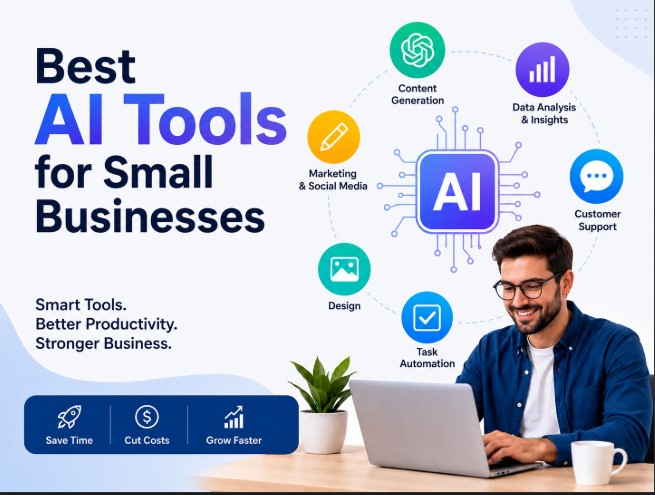
Digital marketing is no longer just about publishing blog posts, running advertisements, or posting on social media. Marketers now have to research audiences, analyze competitors, create content, manage campaigns, personalize customer experiences, and measure results across multiple channels.
Doing all of this manually can take enormous amounts of time.
That is where AI tools for digital marketing can make a meaningful difference. They can help marketers automate repetitive tasks, analyze large amounts of information, generate ideas, optimize campaigns, and make faster data-driven decisions.
But there is an important distinction: the best marketers do not use technology to remove human judgment. They use it to increase productivity and improve decision-making.
In this guide, you’ll discover the most useful categories of digital marketing tools, how they can be used, what to look for when choosing one, common mistakes to avoid, and practical strategies for getting better results.
What Are AI Tools for Digital Marketing?
AI tools for digital marketing are software applications designed to help businesses perform marketing activities using technologies such as machine learning, natural-language processing, predictive analytics, automation, and data analysis.
Depending on the platform, they can assist with:
- Keyword research
- SEO optimization
- Content creation
- Competitor research
- Social media management
- Email marketing
- Customer segmentation
- Lead generation
- Digital advertising
- Marketing analytics
- Conversion optimization
- Campaign reporting
For example, instead of manually reviewing hundreds of search queries, an SEO platform can help organize keywords into related groups. Similarly, an email marketing platform can help segment customers based on their behavior and engagement.
The goal is not simply to automate everything. The goal is to make marketing more efficient while maintaining quality and strategic control.

Why Use AI Tools for Digital Marketing?
The right tools can improve several parts of a marketing operation.
1. Save Time
Marketers spend considerable time on repetitive activities such as:
- Creating content briefs
- Analyzing campaign reports
- Writing multiple ad variations
- Organizing keywords
- Scheduling social posts
- Segmenting audiences
Automation can reduce the amount of manual work involved in these processes.
2. Improve Productivity
A marketer who spends less time on repetitive tasks can spend more time on strategy, customer research, creative development, and campaign optimization.
3. Analyze More Data
Modern marketing generates huge amounts of information. Analytics tools can identify patterns that may be difficult to spot manually.
4. Improve Personalization
Different customers have different needs. Marketing platforms can help businesses create more relevant experiences based on customer behavior, interests, and previous interactions.
5. Scale Marketing Campaigns
A small marketing team can use automation to manage larger campaigns without increasing manual workload at the same rate.
15 Best AI Tools for Digital Marketing
The best software depends on your marketing goals. Instead of choosing a tool simply because it is popular, evaluate it according to the specific problem you need to solve.
1. AI SEO Tools
SEO platforms can help marketers research search opportunities, analyze competitors, optimize pages, and monitor organic performance.
Common SEO features
- Keyword research
- Search-intent analysis
- Competitor analysis
- Content-gap analysis
- On-page optimization
- Internal-link recommendations
- Rank tracking
- Technical SEO analysis
For example, if you are targeting “email marketing software,” an SEO platform may reveal related topics such as email automation, segmentation, email templates, deliverability, and campaign analytics.
These insights can help you build a more complete content strategy instead of writing one article around a single keyword.
2. AI Content Marketing Tools
Content marketing requires constant research and production. Content tools can support marketers throughout the content workflow.
They can help with:
- Blog ideas
- Content outlines
- Headlines
- Product descriptions
- Social media captions
- Email drafts
- Content repurposing
- Editing and proofreading
However, a useful workflow should still include human review.
A practical content workflow
- Research your target audience.
- Identify the search intent.
- Analyze competing content.
- Create a detailed content brief.
- Develop the first draft.
- Add original examples and expertise.
- Verify important facts.
- Edit for clarity and brand voice.
- Optimize the page for search.
- Publish and monitor performance.
The technology can accelerate the process, but experience and originality are what make content genuinely useful.
3. AI Social Media Tools
Managing several social networks can quickly become a full-time responsibility.
Social media management platforms can help with:
- Content calendars
- Post ideas
- Caption creation
- Scheduling
- Audience insights
- Engagement monitoring
- Performance reporting
A single long-form article can also be repurposed into:
- LinkedIn posts
- Short social captions
- Video scripts
- Email content
- Educational posts
- Carousel concepts
This allows marketers to get more value from existing content.
Expert recommendation
Do not copy the exact same post across every platform.
Adapt the format, tone, length, and message to the audience and culture of each channel.
4. AI Email Marketing Tools
Email marketing becomes more effective when messages are relevant to the recipient.
Modern email platforms can assist with:
- Audience segmentation
- Email personalization
- Subject-line testing
- Automated sequences
- Customer journeys
- Campaign analysis
- Follow-up campaigns
A simple customer journey might look like:
Website visitor → Newsletter signup → Welcome email → Educational content → Product recommendation → Follow-up
The objective is not to send as many emails as possible. It is to send useful information at the right stage of the customer journey.
5. AI Advertising Tools
Paid advertising involves continuous testing and optimization.
Advertising platforms can help marketers evaluate:
- Audience segments
- Ad creatives
- Click-through rates
- Conversion rates
- Cost per acquisition
- Campaign performance
- Budget allocation
For example, a business could test several headlines and creative variations instead of relying on one advertisement.
The software can help identify patterns, but marketers still need to determine whether the results align with the company’s goals.
6. AI Analytics Tools
Analytics is one of the most important parts of digital marketing.
Analytics tools can help marketers understand:
- Where website visitors come from
- Which pages attract attention
- Which campaigns generate conversions
- Where users leave the customer journey
- Which channels generate valuable customers
Some important marketing metrics include:
| Metric | What It Measures |
|---|---|
| Traffic | Number of visitors |
| CTR | Percentage of users who click |
| Conversion Rate | Percentage completing a desired action |
| CPA | Cost to acquire a customer or lead |
| ROAS | Revenue compared with advertising spend |
| Engagement | How users interact with content |
| Customer Lifetime Value | Estimated long-term customer value |
Don’t focus only on traffic or impressions. Connect marketing activity to business outcomes.
7. AI Customer Segmentation Tools
Not every customer should receive the same message.
Customer segmentation tools can help businesses divide audiences according to factors such as:
- Purchase history
- Website behavior
- Location
- Engagement
- Product interests
- Customer value
- Stage in the buying journey
For example, an online store could create separate campaigns for first-time visitors, returning customers, and previous buyers.
This can make marketing communications more relevant.
8. AI Lead Generation Tools
Lead generation is essential for businesses that depend on prospects.
Marketing automation platforms can help identify, qualify, organize, and follow up with potential customers.
A basic lead-generation workflow might be:
Landing page → Form submission → Lead qualification → Automated follow-up → Sales conversation
The key is to ensure that automation does not create unnecessary or low-quality leads. Lead quality matters more than lead volume.
9. AI Conversion Optimization Tools
Getting visitors to your website is only part of the job.
Conversion optimization focuses on helping more visitors take meaningful actions, such as:
- Making a purchase
- Requesting a quote
- Booking a consultation
- Signing up for a newsletter
- Downloading a resource
Tools can help marketers identify weak points in the customer journey and test different page elements.
Useful areas to test include:
- Headlines
- Calls to action
- Forms
- Landing-page layouts
- Product messaging
- Offers
10. AI Marketing Reporting Tools
Marketing reports can become difficult to manage when data comes from multiple platforms.
Reporting tools can help bring information together and make it easier to understand.
A useful marketing report should answer three questions:
- What happened?
- Why did it happen?
- What should we do next?
A report that simply displays dozens of numbers is less useful than one that clearly identifies trends and recommended actions.
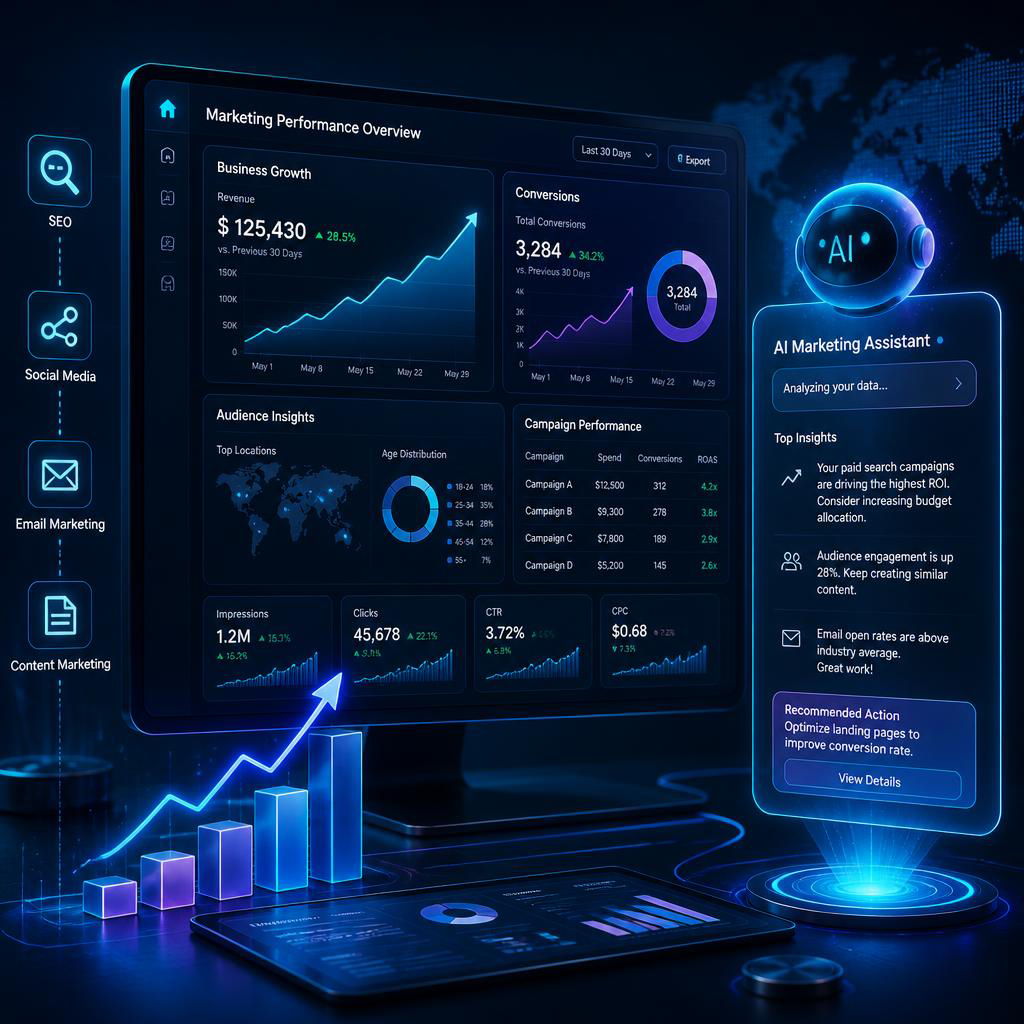
AI Marketing Tools Comparison
| Tool Category | Best For | Main Benefit | Potential Limitation |
|---|---|---|---|
| SEO tools | SEO professionals | Search and competitor research | Can require learning |
| Content tools | Content teams | Faster content workflows | Needs human editing |
| Social media tools | Social teams | Scheduling and management | Platform limitations |
| Email tools | Email marketers | Automation and personalization | Setup can be complex |
| Advertising tools | PPC marketers | Campaign optimization | Requires quality data |
| Analytics tools | Marketing teams | Performance measurement | Data interpretation required |
| CRM tools | Sales and marketing | Lead management | Can be expensive at scale |
| Reporting tools | Agencies and businesses | Centralized reporting | Integration challenges |
How to Choose the Right AI Marketing Tool
Buying the most expensive platform is not necessarily the best decision.
Follow these steps instead.
Step 1: Define the Problem
Start by identifying the bottleneck.
Ask:
- Do I need more organic traffic?
- Is content production too slow?
- Are my social campaigns difficult to manage?
- Do I need better customer segmentation?
- Are advertising costs too high?
- Is reporting taking too much time?
Your answer should determine the type of tool you need.
Step 2: Identify Essential Features
Make a list of must-have features before comparing platforms.
For example, an SEO-focused business might prioritize:
- Keyword research
- Competitor analysis
- Content optimization
- Site auditing
- Rank tracking
- Reporting
Avoid paying for features you will never use.
Step 3: Check Integrations
Your tools should fit into your existing workflow.
Look for compatibility with your:
- Website
- CRM
- Analytics platform
- Email system
- Advertising accounts
- Social media platforms
- Content management system
Poor integration can create more work rather than less.
Step 4: Consider Cost and ROI
Price matters, but it should not be the only consideration.
Consider:
- Monthly subscription
- Number of users
- Usage limits
- Setup costs
- Training requirements
- Integration costs
- Expected time savings
- Potential revenue impact
A low-cost tool that nobody uses is more expensive than a useful platform with a higher subscription.
Best Practices for Using AI Tools
Keep Humans in the Loop
Human review is especially important for:
- Customer-facing content
- Advertising claims
- Brand communications
- Financial information
- Product information
- Important business decisions
Use Data Responsibly
Businesses should understand what customer data their marketing platforms collect and process.
Avoid sharing unnecessary sensitive customer information with third-party services and follow applicable privacy requirements.
Test Before Scaling
Don’t assume that an automated recommendation will improve performance.
Test changes wherever possible.
For example:
Version A: Existing landing page
Version B: Revised landing page
Compare conversion rates before making a large-scale change.
Monitor Business Results
Track meaningful outcomes such as:
- Qualified leads
- Sales
- Conversion rates
- Customer acquisition cost
- Revenue
- Retention
- Return on investment
Common Mistakes to Avoid
Mistake 1: Using Too Many Tools
More software does not automatically mean better marketing.
Build a simple technology stack and add tools only when they solve a genuine problem.
Mistake 2: Publishing Generic Content
Automated drafts often need substantial editing.
Add original research, examples, expert commentary, useful visuals, and real-world experience.
Mistake 3: Ignoring Search Intent
A keyword alone does not tell you everything.
Understand whether searchers want a definition, tutorial, comparison, product recommendation, or solution.
Mistake 4: Trusting Automated Recommendations Blindly
Software can make mistakes.
Verify important information before using it in customer-facing content or strategic decisions.
Mistake 5: Measuring Vanity Metrics
High impressions do not necessarily mean high revenue.
Focus on metrics connected to your business objectives.
Mistake 6: Automating Every Customer Interaction
Automation is useful for repetitive communication, but some customers need human support.
The best strategy combines automation with genuine human interaction.
Expert Tips for Getting Better Results
Start Small
Choose one repetitive workflow and improve it before attempting to automate your entire marketing operation.
Create Reusable Templates
Templates for content briefs, campaign reports, email sequences, and social posts can improve consistency and speed.
Maintain Brand Guidelines
Define your preferred:
- Tone
- Vocabulary
- Writing style
- Messaging
- Customer promises
- Visual identity
This helps maintain consistency across marketing channels.
Review Performance Regularly
A tool that was valuable six months ago may no longer be the best option.
Review your marketing stack periodically and remove redundant software.
Prioritize Customer Value
Technology should make the customer experience better—not simply make the marketing team faster.
Pros and Cons of AI Tools for Digital Marketing
Pros
- Faster marketing workflows
- Reduced repetitive work
- Improved data analysis
- More scalable personalization
- Faster campaign testing
- Easier content planning
- Better reporting
- Increased team productivity
Cons
- Subscription costs
- Learning curves
- Incorrect or incomplete outputs
- Privacy concerns
- Over-automation
- Risk of generic content
- Dependence on third-party platforms
The solution is not to avoid automation. It is to use it strategically.
People Also Ask
Are AI tools good for digital marketing?
Yes. They can help marketers save time, analyze data, personalize campaigns, optimize content, and automate repetitive workflows. Their effectiveness depends on how well they are integrated into an overall marketing strategy.
What is the best AI tool for digital marketing?
There is no single best tool for every business. SEO, content, social media, email, advertising, analytics, and CRM platforms solve different problems. The best choice depends on your goals and workflow.
Can AI tools replace digital marketers?
They can automate certain tasks, but successful marketing still requires strategy, creativity, customer understanding, brand judgment, and decision-making.
Can AI tools improve SEO?
Yes. They can assist with keyword research, topic discovery, content optimization, competitor analysis, internal linking, and performance analysis. Human review remains important.
Are AI marketing tools useful for small businesses?
Yes. Small businesses can use automation to save time and compete more efficiently. The most practical approach is to start with tools that solve specific, high-value problems.
How do AI tools help with social media marketing?
They can assist with content ideas, captions, scheduling, audience analysis, engagement monitoring, and reporting. Marketers should still adapt content to each platform and audience.
How can businesses measure the ROI of marketing tools?
Compare the tool’s cost with measurable benefits such as increased revenue, qualified leads, improved conversion rates, reduced acquisition costs, or significant time savings.
Should every marketing task be automated?
No. Automate repetitive and predictable tasks, but keep human involvement in strategy, creative direction, customer relationships, quality control, and important decisions.
Internal Linking Opportunities
If you are building a website around digital marketing, create supporting articles that link naturally to this guide.
Recommended topics include:
- Best AI SEO Tools for Beginners
- AI Tools for Content Creation
- How to Use AI for Keyword Research
- Best Social Media Marketing Tools
- Email Marketing Automation Guide
- How to Create an SEO Content Strategy
- Digital Marketing Analytics Guide
- Marketing Automation for Small Businesses
- Best Keyword Research Tools
- How to Improve Conversion Rates
This creates a strong topic cluster and gives readers a logical path to explore related subjects.
Authoritative External Reference Opportunities
For credibility, link to primary and authoritative resources when discussing technical or policy-related subjects.
Useful sources include:
- Google Search Central for SEO guidance
- Google Analytics documentation for measurement
- Official advertising-platform documentation for advertising practices
- Official privacy regulators and government resources for data protection
- Official documentation from the marketing platforms you recommend
When discussing a specific product’s features or pricing, link to the provider’s official documentation rather than relying on outdated third-party descriptions.