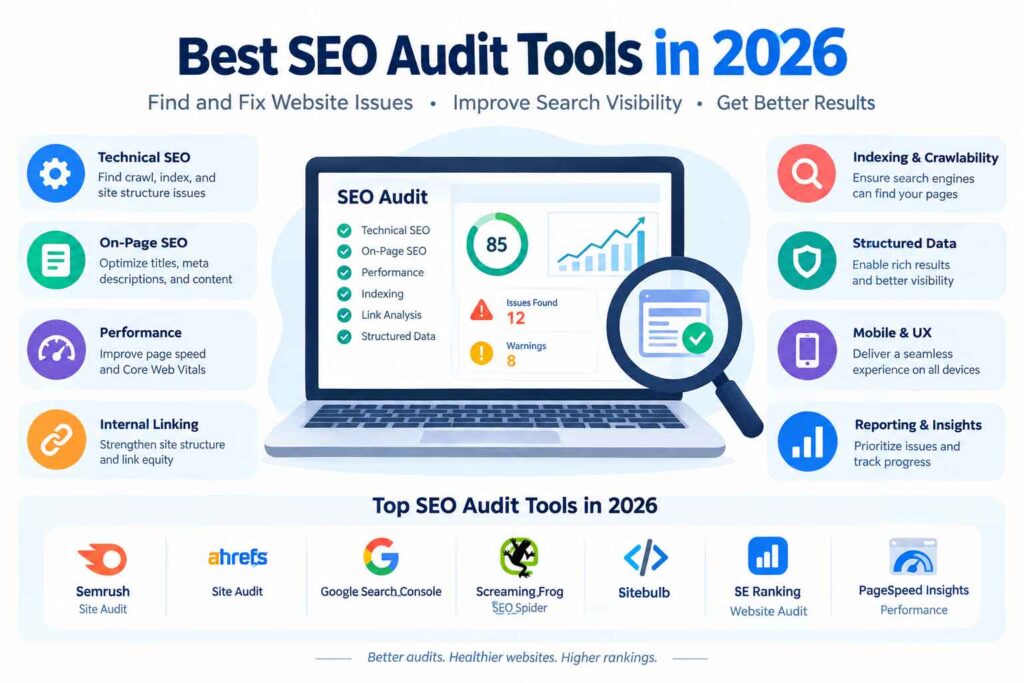
SEO has changed dramatically. Ranking on Google still matters, but search is no longer limited to the traditional list of blue links. AI Overviews, AI-powered search experiences, and answer engines are changing how people discover information, compare products, and find businesses.
At the same time, SEO professionals have more data to analyze than ever before. Keyword research, competitor analysis, content gaps, technical audits, internal linking, rank tracking, and content optimization can quickly become time-consuming manual tasks.
That is where AI SEO tools can help.
The best AI SEO tools in 2026 combine traditional SEO data with automation and intelligent analysis. They can help you identify keyword opportunities, understand search intent, create content briefs, optimize existing pages, detect technical issues, monitor rankings, and measure visibility across traditional and AI-driven search.
But there is an important distinction: AI should support SEO strategy, not replace SEO judgment.
In this guide, we’ll compare 15 of the best AI SEO tools in 2026, explain what each one does best, identify who should use it, and show how to choose the right platform for your goals.
What Are AI SEO Tools?
AI SEO tools are software platforms that use artificial intelligence, machine learning, automation, or AI-assisted workflows to make SEO research and optimization faster and more efficient.
Depending on the platform, an AI SEO tool may help with:
- AI keyword research
- Keyword clustering
- Search intent analysis
- SERP analysis
- Competitor analysis
- Content briefs
- SEO content optimization
- AI-assisted content writing
- On-page SEO
- Technical SEO audits
- Backlink analysis
- Internal linking
- Rank tracking
- Content gap analysis
- AI search visibility
- SEO reporting and automation
The strongest platforms combine AI capabilities with actual search and website data. This matters because AI-generated suggestions without reliable SEO data can produce ideas that sound reasonable but have little ranking potential.
15 Best AI SEO Tools in 2026
Quick Comparison
| Tool | Best For | Key AI/SEO Strength | Ideal User |
|---|---|---|---|
| Semrush | All-in-one SEO | AI search visibility, research, content & audits | Businesses & agencies |
| Ahrefs | SEO research & data | AI keyword research, content, technical SEO | SEO professionals |
| Surfer | Content optimization | SERP-driven content optimization | Content teams |
| Frase | Content workflows | AI content research, optimization & AI visibility | Writers & marketers |
| SE Ranking | SEO management | AI-assisted SEO workflows and tracking | SMBs & agencies |
| Clearscope | Content quality | Topic research and content optimization | Content teams |
| MarketMuse | Content strategy | Topic modeling and content gap analysis | Enterprise teams |
| Scalenut | Content & GEO | AI content planning and AI visibility | Growing businesses |
| Alli AI | SEO automation | Automated on-page optimization | Agencies & large sites |
| Seobility | Affordable SEO | Audits, content optimization and AI visibility | Beginners & SMBs |
| Screaming Frog | Technical SEO | Advanced crawling and AI-assisted workflows | Technical SEOs |
| Rank Math | WordPress SEO | AI content/link workflows and SEO automation | WordPress users |
| Yoast SEO | WordPress optimization | AI-assisted SEO and content workflows | Bloggers & businesses |
| Ubersuggest | Beginner SEO | Keyword and competitor research | Beginners & SMBs |
| LowFruits | Low-competition keywords | Keyword discovery and SERP opportunity analysis | Niche websites |
Note: Features, plans, limits, and pricing can change frequently. Always verify the current plan details before purchasing.
1. Semrush
Best for: All-in-one SEO and AI search visibility
Semrush remains one of the most comprehensive platforms for managing SEO campaigns. It combines keyword research, competitor analysis, site auditing, position tracking, content optimization, and increasingly sophisticated AI-search visibility features.
Its newer AI-focused capabilities allow marketers to monitor how brands appear across AI-powered search experiences and analyze competitive visibility.
Key features
- Keyword research
- Competitor analysis
- Site Audit
- Position Tracking
- Content optimization
- Backlink analysis
- AI search visibility tracking
- AI-powered reporting
- Technical SEO analysis
Pros
- Extremely broad SEO feature set
- Strong competitive intelligence
- Useful for agencies managing multiple clients
- Combines traditional SEO with AI-search monitoring
Cons
- Can feel overwhelming for beginners
- Higher-tier features can become expensive
Best choice for: Businesses and agencies that want one platform covering most areas of SEO.
2. Ahrefs
Best for: SEO research, competitor analysis, backlinks, and AI-assisted workflows
Ahrefs is particularly well known for its backlink database, Site Explorer, Keywords Explorer, Site Audit, and competitive research capabilities.
In 2026, Ahrefs has expanded its AI capabilities considerably. Its AI features include keyword suggestions, search-intent analysis, AI Content Helper, AI-assisted reporting, technical SEO automation, and connections to AI assistants through its SEO MCP.
Key features
- AI keyword suggestions
- AI search intent analysis
- Keyword research
- Backlink analysis
- Competitor research
- Content optimization
- Site Audit
- AI visibility monitoring
- AI-assisted reporting
Pros
- Excellent SEO data
- Strong backlink research
- Powerful competitor analysis
- Useful for advanced SEO professionals
Cons
- Some advanced features require higher plans or add-ons
- Learning curve for new users
Best choice for: SEO professionals who need deep search data combined with modern AI workflows.
3. Surfer
Best for: SEO content optimization
Surfer focuses heavily on content optimization. It analyzes search results and helps writers understand the topics, terms, structure, and content characteristics associated with competing pages.
Its platform has also expanded toward AI search optimization and AI-assisted workflows.
Key features
- Content Editor
- SERP analysis
- Content scoring
- Content optimization
- Keyword clustering
- AI-assisted writing
- AI search optimization
- Content recommendations
Pros
- Easy-to-understand content recommendations
- Excellent for editorial workflows
- Useful for optimizing existing articles
- Strong integration of content and SERP data
Cons
- Primarily focused on content rather than complete technical SEO
- Some advanced capabilities require paid plans
Best choice for: Bloggers, publishers, and content marketing teams focused on organic rankings.
4. Frase
Best for: AI-powered content research and optimization
Frase combines SEO research, content creation, optimization, and AI-search visibility into one workflow.
The platform can analyze top-ranking content, generate briefs, assist with writing, score content, and help identify opportunities for both traditional search and AI search.
Key features
- SEO content research
- Content briefs
- Content optimization
- AI-assisted writing
- Topic research
- Content gap analysis
- AI search optimization
- AI visibility tracking
- Competitor research
Pros
- Strong end-to-end content workflow
- Useful for content teams
- Combines research and writing
- Helpful for updating existing content
Cons
- Less focused on deep backlink research than dedicated SEO platforms
- Best value comes from content-focused workflows
Best choice for: Writers and marketers who want research, writing, optimization, and monitoring in one environment.
5. SE Ranking
Best for: SEO management for businesses and agencies
SE Ranking provides a broad collection of SEO tools, including keyword research, rank tracking, competitor analysis, website auditing, backlink monitoring, and content-related features.
Its broader workflow makes it useful for teams that need to manage several SEO activities without investing in multiple specialized platforms.
Key features
- Rank tracking
- Keyword research
- Competitor analysis
- Website audit
- Backlink monitoring
- Content optimization
- SEO reporting
- AI-assisted workflows
Pros
- Broad SEO toolkit
- Useful reporting features
- Suitable for agencies and small businesses
- Good balance between depth and usability
Cons
- Some advanced features depend on plan level
- Not as specialized as dedicated content platforms
Best choice for: SMBs and agencies looking for a balanced SEO platform.
6. Clearscope
Best for: Content quality and topical relevance
Clearscope is designed around content optimization and topic research. It helps content teams identify relevant queries, understand what audiences are searching for, and improve content coverage.
Its AI-era features also focus on understanding search and AI visibility opportunities.
Key features
- Content optimization
- Topic discovery
- Keyword research
- Content grading
- Content gap analysis
- Search intent research
- AI-search visibility insights
Pros
- Strong content-focused workflow
- Simple interface
- Useful for editorial teams
- Good for improving topical coverage
Cons
- Not designed as a complete technical SEO platform
- Better suited to content teams than technical SEOs
Best choice for: Publishers and content marketing teams that prioritize content quality.
7. MarketMuse
Best for: Enterprise content strategy and topical authority
MarketMuse focuses on content intelligence and strategy rather than simply generating articles.
It can help teams understand topical coverage, content gaps, competitive opportunities, and which pages deserve attention.
Key features
- Topic modeling
- Content gap analysis
- Competitive content analysis
- Content planning
- Topic clusters
- Content optimization
- Content inventory analysis
Pros
- Strong strategic focus
- Useful for large content libraries
- Helps build topical authority
- Good for enterprise content planning
Cons
- More complex than basic SEO tools
- Better suited to experienced teams
Best choice for: Large websites and organizations managing extensive content portfolios.
8. Scalenut
Best for: AI content workflows and AI visibility
Scalenut combines content planning, SEO research, AI-assisted content creation, and AI visibility monitoring.
Its 2026 platform emphasizes Generative Engine Optimization, helping brands understand how AI-powered search systems represent and mention their businesses.
Key features
- Keyword research
- Content planning
- AI content writing
- Content optimization
- Topic research
- AI visibility tracking
- Competitor analysis
- GEO workflows
Pros
- Combines content and AI visibility
- Useful for content marketing teams
- Strong automation capabilities
Cons
- Primarily content-focused
- Beginners may need time to learn the full platform
Best choice for: Businesses building content strategies for both Google and AI-powered search.
9. Alli AI
Best for: Large-scale SEO automation
Alli AI takes a different approach by emphasizing automation. Rather than simply telling you what SEO problems exist, it is designed to help automate optimization tasks across websites.
It also provides ranking monitoring and recommendations that can help SEO teams manage larger websites.
Key features
- Automated on-page SEO
- Rank tracking
- SEO recommendations
- Bulk optimization
- Internal linking
- Technical SEO workflows
- SEO automation
Pros
- Strong automation
- Useful for large websites
- Reduces repetitive optimization tasks
- Suitable for agencies
Cons
- Automated changes still require quality control
- More advanced than necessary for small websites
Best choice for: Agencies and organizations managing large numbers of pages.
10. Seobility
Best for: Affordable SEO management and beginners
Seobility offers website auditing, keyword research, rank tracking, backlink monitoring, content optimization, and AI-oriented SEO capabilities.
Its newer features also address visibility in Google AI Overviews and AI-powered search.
Key features
- Website Audit
- Keyword research
- Rank tracking
- Backlink monitoring
- Competitor analysis
- Content optimization
- AI Overview tracking
- AI-assisted SEO workflows
Pros
- Beginner-friendly
- Strong technical SEO basics
- Useful for small businesses
- Good combination of traditional and AI-focused SEO
Cons
- Less extensive than enterprise SEO platforms
- Advanced users may need additional tools
Best choice for: Beginners, bloggers, and small businesses that want an accessible SEO platform.
11. Screaming Frog SEO Spider
Best for: Technical SEO
Screaming Frog SEO Spider is primarily a technical SEO crawler rather than a conventional AI SEO content platform.
It can crawl websites and uncover problems involving redirects, broken links, metadata, canonicals, structured data, duplicate content, and other technical elements.
In 2026, its MCP capabilities allow AI assistants to interact with SEO Spider workflows, making technical SEO analysis more accessible through natural-language commands.
Key features
- Technical SEO crawling
- Broken link detection
- Redirect analysis
- Metadata analysis
- Canonical checks
- XML sitemap analysis
- Structured data analysis
- AI-assisted crawl workflows
Pros
- Extremely powerful crawler
- Excellent for technical audits
- Highly configurable
- Useful for large websites
Cons
- Steeper learning curve
- Not a complete keyword/content platform
Best choice for: Technical SEO professionals and advanced website audits.
12. Rank Math
Best for: WordPress SEO
Rank Math is a popular WordPress SEO plugin that combines traditional optimization features with AI-assisted tools.
Its newer releases have expanded AI functionality, including AI agents, AI visibility monitoring, link-related automation, and connections that allow AI assistants to work with SEO data.
Key features
- On-page SEO
- Schema markup
- Internal linking
- AI content assistance
- AI visibility
- SEO automation
- Sitemap management
- WordPress integration
Pros
- Deep WordPress integration
- Easy to use from the WordPress dashboard
- Strong schema capabilities
- Useful automation features
Cons
- Primarily designed for WordPress
- Some advanced features require paid plans
Best choice for: WordPress website owners who want SEO and AI features directly inside their CMS.
13. Yoast SEO
Best for: WordPress content optimization
Yoast SEO is one of the most established WordPress SEO plugins. It focuses on making on-page optimization accessible to content creators and website owners.
Its AI-assisted capabilities can help streamline aspects of SEO content creation and optimization.
Key features
- On-page SEO
- Meta title and description optimization
- Schema
- XML sitemaps
- Internal linking
- Content analysis
- AI-assisted SEO workflows
- WordPress integration
Pros
- Beginner-friendly
- Excellent WordPress integration
- Strong foundational SEO features
- Well-established workflow
Cons
- More focused on on-page SEO than advanced competitive research
- Some capabilities require premium features
Best choice for: Bloggers and WordPress businesses that want straightforward SEO optimization.
14. Ubersuggest
Best for: Beginners and small businesses
Ubersuggest provides keyword research, competitor analysis, content ideas, backlink data, and SEO insights in a relatively approachable interface.
For beginners who do not need the complexity of enterprise SEO platforms, it can provide a practical starting point.
Key features
- Keyword research
- Competitor analysis
- Content ideas
- Backlink analysis
- Site auditing
- Rank tracking
- SEO recommendations
Pros
- Beginner-friendly
- Useful keyword research
- Suitable for small websites
- Easier to learn than many enterprise platforms
Cons
- Less comprehensive than premium enterprise suites
- Advanced SEO teams may eventually need additional data sources
Best choice for: Beginners, bloggers, freelancers, and small businesses.
15. LowFruits
Best for: Finding low-competition keyword opportunities
LowFruits focuses on identifying keywords where smaller websites may have opportunities to compete.
Rather than simply showing search volume, the platform emphasizes SERP analysis and identifying weaker competitors within search results.
Key features
- Keyword discovery
- SERP analysis
- Low-competition keyword research
- Competitor analysis
- Keyword clustering
- Content opportunity discovery
Pros
- Useful for niche websites
- Helps uncover less competitive opportunities
- Practical for smaller sites
- Focused workflow
Cons
- More specialized than all-in-one SEO suites
- Not intended to replace a complete technical SEO platform
Best choice for: Bloggers, niche-site owners, and smaller websites targeting achievable keyword opportunities.
How to Choose the Best AI SEO Tool
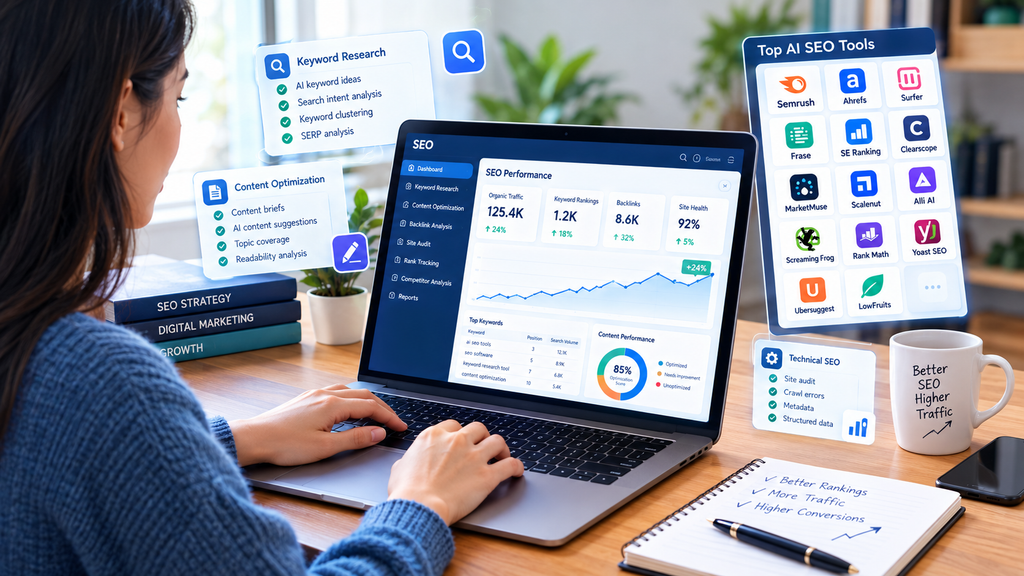
There is no single platform that is perfect for every SEO campaign. Your choice should depend on your website size, SEO experience, budget, and primary objective.
1. Start With Your Main SEO Goal
Ask what you actually need.
If your biggest problem is keyword research, prioritize a tool with strong keyword databases and search-intent analysis.
If your challenge is content optimization, look for SERP-based content analysis and topic coverage.
If you manage a large website, prioritize technical SEO automation and crawling.
If AI search visibility is important, choose a platform that tracks brand mentions and citations across AI-powered search systems.
2. Consider Your Website Size
A small blog does not necessarily need an enterprise SEO suite.
For beginners
Consider:
- Seobility
- Ubersuggest
- Yoast SEO
- Rank Math
- LowFruits
For growing businesses
Consider:
- Semrush
- Ahrefs
- SE Ranking
- Surfer
- Frase
For large teams and agencies
Consider:
- Semrush
- Ahrefs
- MarketMuse
- Alli AI
- Screaming Frog
3. Look Beyond AI Content Generation
One common mistake is choosing an AI SEO platform simply because it can generate articles.
Content generation is only one part of SEO.
A stronger platform should help you answer questions such as:
- What keywords should I target?
- What does search intent look like?
- Who currently ranks?
- What topics are missing from my page?
- Are there technical problems?
- Which pages are losing traffic?
- What backlinks do competitors have?
- How are rankings changing?
- Is my brand appearing in AI search results?
The more of these questions a platform can answer with reliable data, the more useful it becomes for an SEO workflow.
Best Practices for Using AI SEO Tools
Use AI for Research, Not Blind Decision-Making
AI can process large amounts of information quickly, but you should still validate important SEO decisions using real search results and reliable data.
Analyze Search Intent Before Writing
Before targeting a keyword, inspect the SERP.
Determine whether searchers primarily want:
- A tutorial
- A comparison
- A product
- A list
- A definition
- A service
- A specific website
Matching intent is often more important than simply repeating a keyword throughout an article.
Build Topic Clusters
Instead of creating isolated articles, connect related content around a central topic.
For example:
Pillar: AI SEO Tools
Supporting content could include:
- Best AI Keyword Research Tools
- Best AI Content Optimization Tools
- Best Technical SEO Tools
- Best Rank Tracking Tools
- Best Free SEO Tools
- AI SEO for Small Businesses
This structure can strengthen topical coverage and create useful internal linking opportunities.
Use AI to Improve Existing Content
Do not only use AI SEO tools for new articles.
Analyze existing pages for:
- Declining rankings
- Outdated information
- Missing subtopics
- Weak internal links
- Poor search intent alignment
- Missing entities
- Thin sections
- Technical problems
Refreshing a page that already has backlinks and historical authority can sometimes be more efficient than starting from zero.
Common AI SEO Mistakes to Avoid
1. Publishing AI-generated content without editing
Generated content can be repetitive, generic, inaccurate, or disconnected from the actual audience.
Always add original insights, examples, experience, data, and editorial judgment.
2. Ignoring search intent
A perfectly optimized article can still struggle if it does not satisfy what users actually want.
3. Focusing only on keyword density
Modern SEO is not about repeating a keyword as many times as possible.
Focus on:
- Relevance
- Search intent
- Topic coverage
- Helpful information
- Clear structure
- Internal linking
- Technical quality
4. Automating technical changes without quality control
Automation can save time, but incorrect redirects, metadata, canonical tags, or internal links can create new problems.
Review important changes before deploying them at scale.
5. Treating AI search as a replacement for SEO
AI-powered search does not eliminate the importance of strong websites, useful content, technical accessibility, and authority.
Instead, it creates another visibility layer that SEO teams increasingly need to monitor.
Expert Tips for Getting Better Results
Combine Specialized Tools
You do not necessarily need one tool to do everything.
For example, an SEO team could use:
Ahrefs + Surfer + Screaming Frog
for research, content optimization, and technical auditing.
Another team might prefer:
Semrush + Frase
for broader SEO research and content workflows.
The best combination depends on your workflow rather than the number of features a platform advertises.
Track Business Metrics, Not Just Rankings
Rankings are useful, but they are not the final objective.
Also monitor:
- Organic traffic
- Qualified leads
- Sales
- Conversion rate
- Revenue
- Assisted conversions
- Branded search demand
- AI search visibility
A keyword moving from position 8 to position 5 matters more when it produces meaningful business results.
Keep Human Expertise in the Workflow
The most effective approach is usually:
Data → AI analysis → Human judgment → Implementation → Measurement
AI can accelerate repetitive work, but strategy still requires understanding the audience, market, business, and brand.
Frequently Asked Questions
What are the best AI SEO tools in 2026?
Some of the leading options include Semrush, Ahrefs, Surfer, Frase, SE Ranking, Clearscope, MarketMuse, Scalenut, Alli AI, Seobility, Screaming Frog, Rank Math, Yoast SEO, Ubersuggest, and LowFruits. The right choice depends on whether your priority is keyword research, content optimization, technical SEO, automation, or AI search visibility.
Are AI SEO tools worth it?
They can be valuable when they save time, improve research quality, identify opportunities, or automate repetitive SEO tasks. Their value depends on how effectively you use the data and recommendations rather than simply generating content automatically.
What is the best AI SEO tool for beginners?
Beginner-friendly options include Seobility, Ubersuggest, Yoast SEO, Rank Math, and LowFruits. These tools can provide useful SEO workflows without requiring the same level of expertise as more complex enterprise platforms.
What is the best AI SEO tool for keyword research?
Ahrefs and Semrush are strong choices for comprehensive keyword and competitor research. LowFruits can be particularly useful when the goal is finding lower-competition opportunities.
What is the best AI SEO tool for content optimization?
Surfer, Frase, and Clearscope are strong options for content optimization. They focus heavily on analyzing competing content, topical coverage, and opportunities to improve relevance.
Can AI SEO tools improve Google rankings?
They can help identify and address SEO opportunities, but no tool can guarantee a ranking. Rankings depend on many factors, including relevance, search intent, content quality, competition, authority, technical accessibility, and search-engine systems.
Are there free AI SEO tools?
Yes. Several SEO platforms offer free plans, free tools, or limited free functionality. However, free versions usually have restrictions on data, projects, queries, or advanced features.
Can AI SEO tools help with AI search visibility?
Yes. A growing number of SEO platforms now include features for monitoring visibility in AI-powered search experiences. These can help track mentions, citations, prompts, competitors, and changes in AI visibility.