
Choosing between Semrush vs Ahrefs is one of the most common decisions SEO professionals face.
Both platforms provide powerful tools for keyword research, competitor analysis, backlink research, rank tracking, technical SEO, and content strategy. But they are not identical. Each platform approaches SEO data differently, and the better fit depends heavily on what you need to accomplish.
A blogger researching content opportunities may care most about keyword discovery and SERP analysis. An agency may prioritize rank tracking, client reporting, and competitor research. A link-building specialist may spend most of their time analyzing backlinks and referring domains.
That is why simply asking whether Semrush or Ahrefs is better does not tell the whole story.
This guide compares Semrush and Ahrefs across the areas that matter most, including keyword research, backlink analysis, competitor research, rank tracking, technical SEO, content research, pricing, usability, and overall workflow.
By the end, you will have a clearer understanding of which platform fits different SEO needs.
Semrush vs Ahrefs: Quick Comparison
| Feature | Semrush | Ahrefs |
|---|---|---|
| Keyword Research | Excellent | Excellent |
| Backlink Analysis | Excellent | Excellent |
| Competitor Analysis | Excellent | Excellent |
| Rank Tracking | Excellent | Excellent |
| Site Audit | Excellent | Excellent |
| Content Research | Excellent | Excellent |
| Technical SEO | Excellent | Excellent |
| SERP Analysis | Excellent | Excellent |
| PPC Research | Excellent | Good |
| Link-Building Research | Excellent | Excellent |
| Agency Reporting | Excellent | Good |
| Local SEO | Strong | Strong |
| AI/Search Visibility | Strong | Strong |
| Beginner Friendliness | Moderate | Moderate |
| Best For | Broad SEO & marketing workflows | SEO, links & competitive research |
Important: Feature availability and limits can vary by subscription plan and may change over time. Always check the current plan details before purchasing.

What Is Semrush?
Semrush is a broad digital marketing and SEO platform that combines search research with tools for content, competitive analysis, advertising, local visibility, reporting, and newer AI-search visibility workflows.
Its SEO ecosystem includes tools for:
- Keyword research
- Competitor analysis
- Backlink analysis
- Rank tracking
- Technical site audits
- On-page optimization
- Content research
- Local SEO
- SERP analysis
- Reporting
- Advertising research
- AI visibility monitoring
One of Semrush’s major advantages is the breadth of its ecosystem.
For example, an SEO professional can research a competitor’s keywords, identify content gaps, inspect backlinks, track rankings, audit a website, and create reports without constantly switching platforms.
Semrush strengths
- Broad SEO toolkit
- Strong competitor intelligence
- Keyword Gap research
- Backlink analysis
- Technical SEO auditing
- Rank tracking
- PPC research
- Local SEO functionality
- Reporting and agency workflows
- Content and optimization tools
Semrush limitations
- Large feature set can feel overwhelming
- Costs can increase as additional capabilities are required
- Beginners may not use many advanced features
- Some limits depend heavily on the selected plan
What Is Ahrefs?
Ahrefs is a major SEO and digital marketing platform known for its extensive web data and strong capabilities in backlink research, competitor analysis, keyword research, content discovery, rank tracking, and technical SEO.
Its core tools include:
- Site Explorer
- Keywords Explorer
- Rank Tracker
- Site Audit
- Content Explorer
- Competitive Analysis
- Link Intersect
- Content Gap
- GSC-related reporting
- AI and brand visibility tools
Ahrefs has traditionally been particularly popular among SEO professionals focused on backlinks, competitor research, content opportunities, and organic search analysis.
Ahrefs strengths
- Strong backlink intelligence
- Detailed competitor research
- Powerful keyword research
- Content opportunity discovery
- Technical SEO auditing
- Rank tracking
- Content Gap analysis
- Link-building research
- Large web-scale data resources
Ahrefs limitations
- Advanced functionality can require a learning curve
- Pricing and usage limits vary by plan
- Some users may not need its full feature set
- Certain workflows can require understanding multiple reports and metrics
Semrush vs Ahrefs for Keyword Research
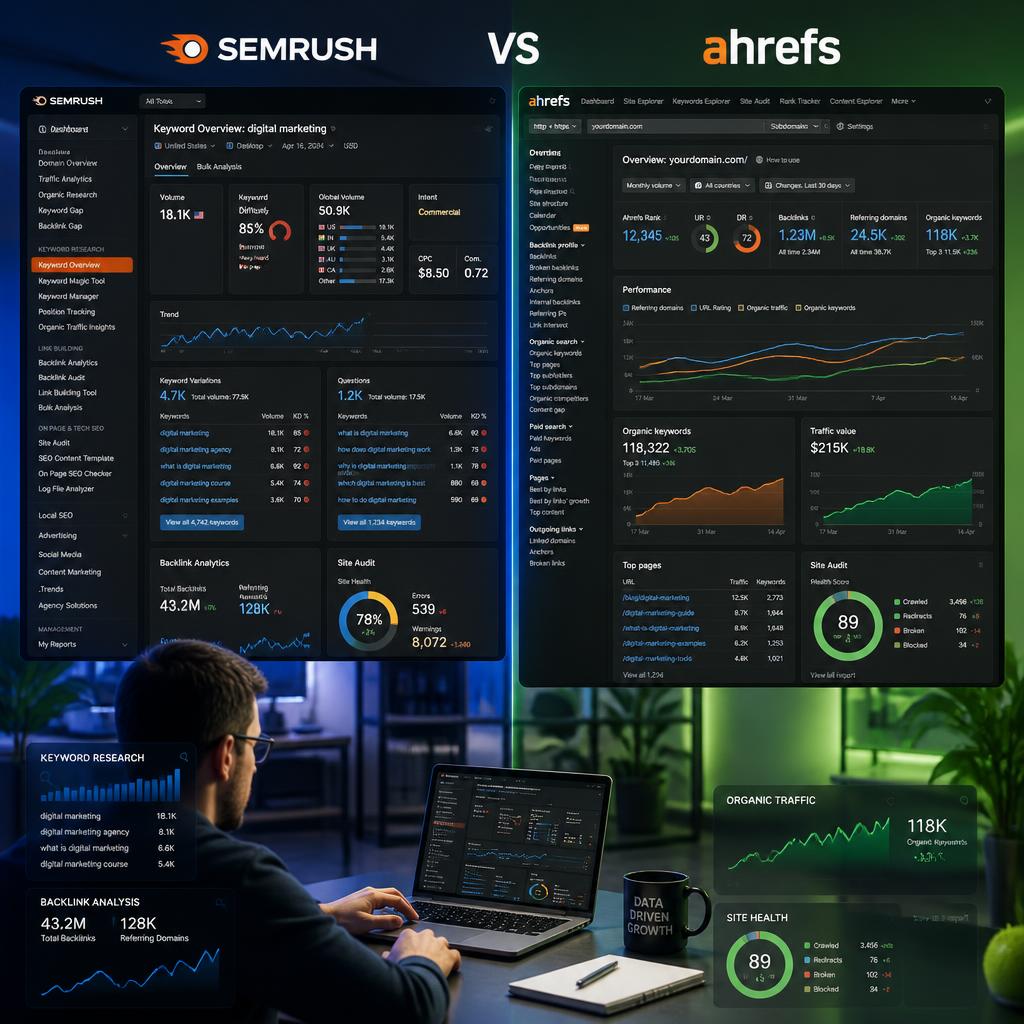
Keyword research is one of the most important areas to compare.
Both platforms can help you discover keyword ideas, evaluate search demand, study competitors, analyze SERPs, and identify content opportunities.
Semrush Keyword Research
Semrush offers a large keyword research ecosystem that includes tools such as Keyword Magic Tool, Keyword Overview, Organic Research, Keyword Gap, and related content-planning functionality.
You can use Semrush to:
- Find keyword variations
- Group keywords by topic
- Analyze keyword difficulty
- Study search intent
- Identify competitor keywords
- Find keyword gaps
- Discover long-tail opportunities
- Analyze SERP features
- Track keyword rankings
Semrush also emphasizes regional keyword databases and competitive keyword analysis.
Best use case
Semrush is particularly useful when keyword research is closely connected to competitor research and content planning.
Ahrefs Keyword Research
Ahrefs Keywords Explorer is designed for discovering and evaluating keywords across a large keyword database.
It provides information such as:
- Search volume
- Keyword difficulty
- Traffic potential
- Parent topics
- SERP information
- Related keyword ideas
- Click-related metrics
- Ranking opportunities
Ahrefs is particularly useful when you want to move from a keyword idea toward a broader content opportunity.
Best use case
Ahrefs works well for SEOs who want to combine keyword research, competitor analysis, content opportunities, and traffic potential.
Semrush vs Ahrefs for Backlink Analysis
Backlinks are an area where both platforms are especially powerful.
Semrush Backlink Analysis
Semrush provides backlink analysis for your website and competitors. You can examine referring domains, backlink sources, anchor text, authority-related metrics, and link-building opportunities.
Its competitive link analysis can help you identify websites linking to competitors but not to your own site.
This can support outreach and link-building campaigns.
Ahrefs Backlink Analysis
Ahrefs has historically been particularly well known for backlink research.
Site Explorer allows you to investigate:
- Referring domains
- Backlinks
- Broken backlinks
- Organic keywords
- Top pages
- Link growth
- Competitor links
- Link opportunities
Ahrefs also provides metrics such as Domain Rating (DR) and URL Rating (UR).
These are third-party SEO metrics, not Google ranking factors.
What should you use?
Both tools are capable backlink platforms. Your choice should depend on the reports, database coverage, workflow, export limits, and other SEO tasks you need alongside link analysis.
Semrush vs Ahrefs for Competitor Analysis
Competitor research is another major area of overlap.
Semrush Competitor Analysis
Semrush provides a wide range of competitive research features.
You can investigate:
- Competitor organic keywords
- Keyword gaps
- Traffic estimates
- Top-performing pages
- Backlink profiles
- Paid search activity
- Advertising keywords
- SERP visibility
- Content opportunities
One advantage is that Semrush connects SEO competitor research with broader digital marketing intelligence.
This can be useful if your competitors are active in both organic search and paid advertising.
Ahrefs Competitor Analysis
Ahrefs focuses heavily on understanding how competing websites earn organic visibility.
Site Explorer, Content Gap, Competitive Analysis, and backlink-related tools can help you identify:
- Keywords competitors rank for
- Pages generating organic traffic
- Competitor backlinks
- Content gaps
- Link-building prospects
- Search visibility trends
Ahrefs is especially useful for reverse-engineering a competitor’s organic search strategy.
Semrush vs Ahrefs for Rank Tracking
Rank tracking is essential for measuring whether an SEO strategy is actually working.
Both platforms allow users to monitor keyword positions and search visibility.
Semrush rank tracking
Semrush’s Position Tracking can monitor rankings across locations, devices, search engines, SERP features, and competitor domains. It also supports newer search-visibility workflows.
Ahrefs rank tracking
Ahrefs Rank Tracker supports keyword monitoring across many countries and devices, with competitor visibility and ranking reports.
What matters most?
Do not choose a rank tracker based only on the number of keywords it can track.
Look at:
- Daily versus weekly updates
- Local tracking
- Mobile tracking
- Desktop tracking
- Competitor tracking
- SERP feature monitoring
- Reporting
- Historical data
- Keyword limits
- Location limits
Your actual tracking requirements matter more than the headline feature list.
Semrush vs Ahrefs for Technical SEO
Both platforms offer site auditing functionality.
Semrush Site Audit
Semrush Site Audit can crawl websites and identify technical and on-page SEO issues, including problems related to:
- Crawlability
- Internal linking
- HTTPS
- Metadata
- Broken pages
- Duplicate content
- Structured data
- Site architecture
- Performance-related issues
It is particularly useful when you want technical auditing integrated into a larger SEO platform.
Ahrefs Site Audit
Ahrefs Site Audit checks websites for a broad range of technical and on-page issues.
It can help identify:
- Broken links
- Redirect problems
- Indexability issues
- Metadata problems
- Duplicate content
- Internal linking issues
- Canonical issues
- Performance-related problems
Which one should you use?
Both are capable of handling routine technical SEO audits.
For very large or highly technical crawling projects, however, some SEO professionals may prefer a dedicated crawler such as Screaming Frog alongside their primary SEO platform.
Semrush vs Ahrefs for Content Research
Content strategy is no longer simply about finding a keyword and writing an article.
You need to understand:
- Search intent
- Competing content
- Topic coverage
- SERP features
- Content gaps
- Backlink opportunities
- Existing page performance
Semrush
Semrush connects keyword research with content optimization, topic research, competitor analysis, and content planning.
Its Keyword Gap and competitive research workflows can help identify topics your competitors are ranking for but your website is not.
Ahrefs
Ahrefs provides Content Explorer, Content Gap, Keywords Explorer, and competitive research tools.
Content Explorer can be useful for finding popular pages and potential link-building opportunities within a topic.
Practical difference
If your content workflow includes broader marketing, competitor, PPC, and reporting research, Semrush provides a very broad ecosystem.
If your workflow revolves heavily around organic search, content gaps, links, and competitor pages, Ahrefs is particularly well suited.
Semrush vs Ahrefs Pricing
Pricing is one of the most important factors, but it is also one of the easiest areas to misunderstand.
Both companies offer multiple plans, and the available features, projects, keyword limits, crawl credits, users, historical data, and other allowances differ by subscription.
Current published pricing shows that Ahrefs offers a free tier, a Starter plan, and paid plans such as Lite, Standard, Advanced, and Enterprise. Semrush similarly offers multiple subscription levels and separate or bundled toolkits depending on the customer’s needs.
Because pricing and plan structures can change, compare the current official pricing pages immediately before purchasing.
What to compare besides monthly price
| Pricing Factor | Why It Matters |
|---|---|
| Projects | Determines how many websites you can manage |
| Tracked keywords | Important for ongoing rank monitoring |
| Keyword research limits | Affects daily research volume |
| Crawl limits | Important for technical SEO |
| Historical data | Useful for trend analysis |
| User seats | Important for teams and agencies |
| Reports | Matters for client work |
| Exports | Important for large-scale research |
| API access | Relevant to advanced workflows |
| Additional toolkits | Can significantly affect total cost |
The cheapest subscription is not necessarily the cheapest solution for your workflow.
Semrush vs Ahrefs: Pros and Cons
Semrush Pros
- Broad SEO and marketing ecosystem
- Excellent competitor analysis
- Strong keyword research
- Powerful technical auditing
- Backlink analysis
- Rank tracking
- PPC research
- Agency reporting
- Local SEO capabilities
Semrush Cons
- Can feel complex
- More features can mean a steeper learning curve
- Total cost may increase with additional requirements
- Some users may not need its full marketing ecosystem
Ahrefs Pros
- Strong backlink analysis
- Excellent competitor research
- Powerful keyword research
- Content discovery tools
- Technical site auditing
- Rank tracking
- Strong link-building workflows
- Extensive web-scale data
Ahrefs Cons
- Learning curve for advanced workflows
- Plan limits need careful consideration
- Some features may be unnecessary for basic SEO
- Total value depends heavily on how frequently you use the platform
Semrush vs Ahrefs: Which Tool Should You Choose?
Instead of looking for a universal winner, match the platform to your SEO workflow.
Choose Semrush if you need:
- Broad SEO functionality
- PPC competitor research
- Detailed competitor intelligence
- Strong keyword gap analysis
- Technical SEO
- Local SEO
- Marketing reports
- A broader digital marketing ecosystem
Consider Ahrefs if you need:
- Strong backlink research
- Organic competitor analysis
- Content opportunity discovery
- Link-building research
- Keyword research
- Content Gap analysis
- Technical SEO
- Organic search-focused workflows
For agencies
Agencies should compare:
- Number of clients
- Projects
- Tracked keywords
- Report limits
- White-label capabilities
- User accounts
- Export functionality
- Historical data
- Automation
- Local SEO requirements
Do not choose solely based on which dashboard looks easier.
How to Compare Semrush and Ahrefs Before Buying
A practical test is more useful than reading dozens of feature lists.
Step 1: Choose three real competitors
Use competitors from your own industry.
Step 2: Research the same keywords
Compare:
- Search volume
- Difficulty
- SERP results
- Keyword suggestions
- Search intent
- Traffic potential
Step 3: Analyze the same backlink profiles
Check:
- Referring domains
- Backlinks
- Anchor text
- Link opportunities
- Competitor link gaps
Step 4: Run the same website audit
Compare how each platform identifies technical and on-page problems.
Step 5: Test rank tracking
Track a sample of your important keywords and examine:
- Location accuracy
- Update frequency
- SERP features
- Competitor visibility
- Reporting
Step 6: Calculate the real cost
Consider your required limits, additional users, projects, reports, and add-ons rather than comparing only the advertised starting price.
Best Practices for Using Semrush or Ahrefs
Use both your SEO platform and first-party data
Third-party SEO platforms are excellent for research, discovery, and competitive analysis.
For your own website, combine them with:
- Google Search Console
- Google Analytics
- Server logs when available
- Conversion data
- Business revenue data
This creates a more complete picture.
Validate important opportunities manually
A keyword score does not understand your entire business.
Before targeting an important keyword, examine the SERP yourself.
Ask:
- What type of content ranks?
- Is the intent informational or commercial?
- Are the results dominated by major brands?
- What content formats appear?
- Are there featured snippets?
- Are forums or videos appearing?
- Can your website realistically provide something better?
Track business outcomes
Do not stop at rankings.
Measure:
- Organic clicks
- Qualified traffic
- Leads
- Sales
- Sign-ups
- Conversion rate
- Revenue
SEO metrics should support business decisions.
Common Mistakes When Choosing Between Semrush and Ahrefs
1. Treating SEO metrics as exact measurements
Traffic estimates, keyword volumes, difficulty scores, and authority metrics are useful for analysis, but they are not guaranteed measurements of future performance.
2. Choosing based only on backlink data
Backlinks are important, but keyword research, technical SEO, content analysis, rank tracking, and reporting may be equally important.
3. Ignoring your geographic market
An SEO tool may provide different data coverage depending on the country, language, device, and search engine.
If you operate internationally, test the markets that actually matter to your business.
4. Paying for features you never use
A large feature list can look impressive.
But if you only need keyword research and rank tracking, paying for extensive marketing functionality may not improve your results.
5. Comparing only the starting price
Always compare usage limits and included features.
A plan that looks cheaper initially may become more expensive once you add the capabilities your workflow requires.
Expert Tips for Getting Better Results
1. Build a competitor database
Keep a fixed list of meaningful competitors and review them regularly.
This makes competitive research more useful than repeatedly analyzing random domains.
2. Look for keyword gaps
Find terms competitors rank for that your website does not.
Then determine whether those terms represent genuine opportunities based on search intent and business relevance.
3. Study top-performing pages
Don’t just copy competitor keywords.
Analyze:
- Content structure
- Search intent
- Topic depth
- Internal links
- Backlinks
- SERP features
- User experience
Then develop a better resource.
4. Combine keyword and content research
A keyword is only the beginning.
Build topic clusters around related queries and create useful pages that satisfy different stages of the search journey.
5. Review SEO data regularly
A monthly or quarterly review can reveal trends that individual keyword checks miss.
Look for:
- Ranking gains
- Ranking losses
- New competitors
- Lost backlinks
- New backlink opportunities
- Content decay
- Technical problems
Frequently Asked Questions
Is Semrush better than Ahrefs?
Semrush and Ahrefs excel in overlapping but somewhat different workflows. Semrush provides a particularly broad SEO and digital marketing ecosystem, while Ahrefs is especially well known for backlinks, organic competitor research, keywords, and content opportunities. The appropriate choice depends on your priorities.
Is Ahrefs better than Semrush for backlinks?
Both provide extensive backlink research capabilities. Ahrefs has a particularly strong reputation for backlink analysis, while Semrush combines backlink research with a broader collection of SEO and marketing tools.
Which is better for keyword research, Semrush or Ahrefs?
Both are powerful keyword research platforms. Semrush is useful for keyword discovery, competitor keyword gaps, and broader marketing research. Ahrefs is strong for keyword metrics, content opportunities, competitor research, and traffic potential analysis.
Which tool is better for beginners?
Neither platform is a basic SEO tool. Both have extensive functionality and can require time to learn.
A beginner who only needs simple keyword research may find a lighter SEO platform easier. However, learning either Semrush or Ahrefs can provide a strong foundation for more advanced SEO work.
Can I use Semrush and Ahrefs together?
Yes. Some SEO professionals use both platforms because their datasets and workflows can complement each other.
For example, one platform can be used for broader competitor and marketing research while the other is used for backlink or content analysis.
The downside is the additional subscription cost.
Which is better for competitor analysis?
Both are strong competitor research platforms. Semrush offers broad competitor intelligence across organic search and advertising, while Ahrefs is particularly useful for reverse-engineering competitors’ organic keywords, pages, backlinks, and content gaps.
Which is better for technical SEO?
Both offer comprehensive site auditing tools. For advanced technical crawling, many professionals also use a dedicated crawler such as Screaming Frog alongside either platform.
Which is better for agencies?
Agencies should compare projects, keyword limits, reporting, users, exports, historical data, local SEO capabilities, and automation.
Semrush can be particularly attractive when an agency needs a broad SEO and marketing reporting ecosystem. Ahrefs can be particularly useful for agencies focused heavily on organic search, backlinks, and competitive research.
Do Semrush and Ahrefs show the same keyword data?
Not necessarily. Each platform maintains its own databases, crawling systems, calculations, and methodologies. Search volume, keyword difficulty, traffic estimates, backlinks, and other metrics can therefore differ.
This is normal.
Should I switch from Ahrefs to Semrush?
The answer depends on what is missing from your current workflow.
Before switching, identify the specific limitation you want to solve and test the alternative using your own websites, keywords, competitors, and reporting requirements.
Should I switch from Semrush to Ahrefs?
Consider switching only if Ahrefs provides capabilities that better match your actual SEO workflow.
Run a side-by-side test before cancelling your existing subscription, especially if historical data or ongoing rank tracking is important to your business.
Internal Linking Opportunities
If this article is part of an SEO tools content cluster, consider linking it naturally to related articles such as:
- Semrush Alternatives in 2026
- Ahrefs Alternatives in 2026
- Moz Alternatives in 2026
- Ubersuggest Alternatives in 2026
- Best SEO Audit Tools in 2026
- Best Free SEO Audit Tools
- Best Backlink Checker Tools in 2026
- Best On-Page SEO Tools in 2026
- Best SERP Analysis Tools in 2026
- Best Keyword Research Tools in 2026
- Best Rank Tracking Tools in 2026
Use descriptive anchor text and link only where the destination genuinely helps the reader.
Authoritative External References
For supporting information and current product details, useful reference sources include:
- Semrush official features and documentation
- Semrush official pricing
- Ahrefs official tools and documentation
- Ahrefs official pricing
- Google Search Central
- Google Search Console
- Google Analytics documentation
Because SEO platforms frequently update their features, databases, pricing, and plan limits, verify current details directly with the provider before making purchasing decisions.

Pingback: 10 Best SEO Tools for Keyword Research, Backlinks & Competitor Analysis